Mastering English Verb Tenses
✅ Reviewed by Emma Caldwell, ELT Editor — CELTA & DELTA, for accuracy against current ELT practice and exam specifications.
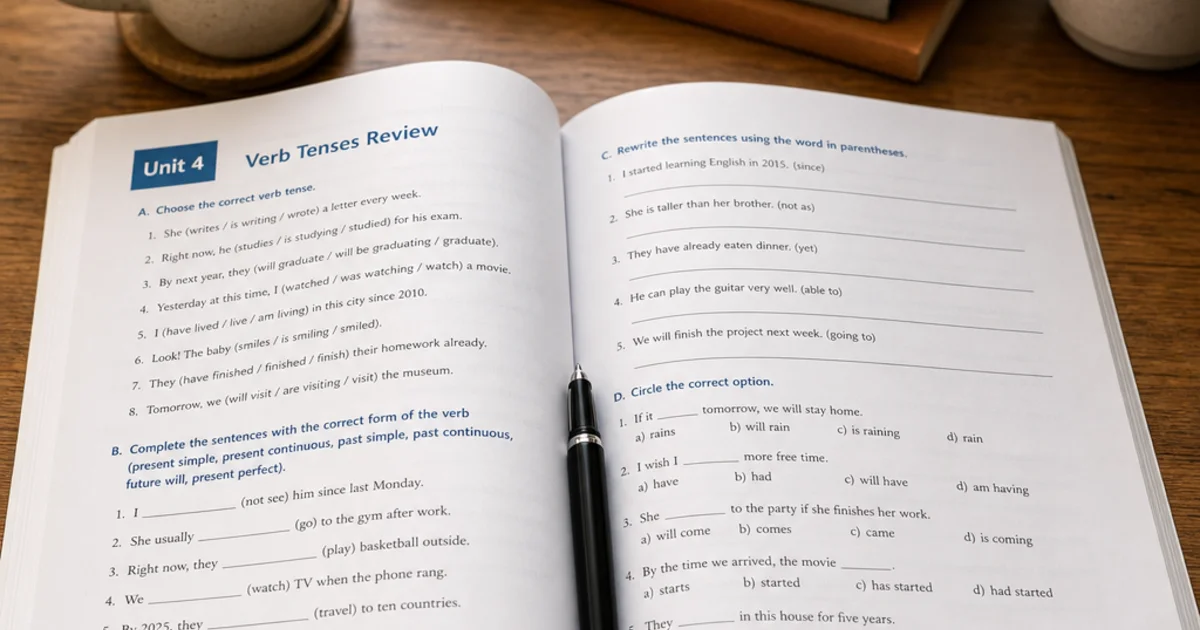
The two ideas: time and aspect
Every tense combines a time (past, present, future) with an aspect (simple, continuous, perfect). The time tells when; the aspect tells how the action unfolds. Simple shows a fact or habit, continuous shows an action in progress, and perfect shows a completed action linked to another time.
The present tenses
Simple present: facts, habits, schedules. The train leaves at 7 a.m. Signal words: always, usually, every day.
Present continuous: happening now or around now. She is studying for her exam this week. Signal words: now, at the moment, currently.
Present perfect: past action with present relevance. I have lived here since 2018. Signal words: since, for, already, yet, ever.
Present perfect continuous: ongoing action with present result. I have been waiting for an hour.
The past tenses
Simple past: a finished action at a definite time. I visited Paris last summer. Signal words: yesterday, ago, in 2019.
Past continuous: an action in progress at a past moment. I was cooking when the phone rang.
Past perfect: an action completed before another past action. By the time we arrived, the film had started.
The future tenses
Will: decisions, predictions, promises made now. I’ll help you with that.
Going to: plans and visible evidence. Look at those clouds — it’s going to rain.
Future continuous: an action in progress at a future time. This time tomorrow I will be flying to Tokyo.
Tense errors learners make most
Incorrect: I am living here since 2018. — mixing continuous with a duration that needs perfect. Correct: I have lived here since 2018.
Incorrect: Yesterday I go to the market. — using present for a finished past action. Correct: Yesterday I went to the market.
Incorrect: I have seen that movie last week. — present perfect with a finished-time marker. Correct: I saw that movie last week.
Perfect tenses: connecting past and present
Perfect tenses use have or had plus a past participle to show how one time relates to another. The present perfect links the past to the present: “I have lived here for five years” means the living started in the past and continues now. The past perfect shows that one past action occurred before another: “By the time we arrived, the film had started.” The future perfect projects completion before a future point: “By next June, I will have finished my degree.”
The present perfect causes the most difficulty because many languages do not have an equivalent. The key insight is that the present perfect is a present tense — it describes the current relevance of a past event. “I have lost my keys” means the keys are still lost now. “I lost my keys” (simple past) suggests the loss is a completed event, perhaps now resolved. Americans often prefer the simple past where British speakers use the present perfect (“Did you eat yet?” vs “Have you eaten yet?”), and both are acceptable in their respective varieties. The important thing is to feel the difference between an action that is finished and sealed off, and one whose effects reach into the present.
Continuous tenses: focusing on duration and process
Continuous (or progressive) tenses use a form of be plus the -ing participle to show that an action was, is, or will be in progress at a particular moment. “I was reading when she called” — the reading was ongoing and was interrupted. “She is studying for her exam” — the studying is happening around now, not necessarily at this exact second. “This time next year, I will be working in London” — an action in progress at a future point.
Not all verbs use continuous forms naturally. Stative verbs — those describing states rather than actions — typically use simple tenses even when referring to the present. Know, believe, own, belong, prefer, and seem are stative: we say “I know the answer,” not “I am knowing the answer.” Some verbs can be both stative and dynamic depending on meaning: “I have a car” (stative = possession) vs “I am having lunch” (dynamic = eating). Learning which verbs are typically stative prevents one of the most common errors in English, and the list is small enough to master with targeted practice.
Lesson summary
- English tenses combine time (past, present, future) with aspect (simple, continuous, perfect).
- Perfect tenses connect past events to the present or show sequence between past actions.
- Continuous tenses show actions in progress; stative verbs (know, own, seem) rarely take continuous forms.
- The present perfect is a present tense describing the current relevance of a past event.
- Learn irregular past forms through exposure and practice; they resist rule-based prediction.
Learner questions
What is the difference between simple past and present perfect?
When do I use ‘will’ versus ‘going to’?
What is the difference between 'I have been to Paris' and 'I went to Paris'?
When do I use the past perfect?
Further reading
Guidance is drawn from the authoritative ELT sources above. Examples and explanations are provided for educational purposes; always check current exam specifications on the official test websites.