Mastering English Grammar
✅ Reviewed by Emma Caldwell, ELT Editor — CELTA & DELTA, for accuracy against current ELT practice and exam specifications.
The backbone: subject, verb, object
Almost every English sentence follows a small set of patterns. The most common is subject – verb – object: She reads books. A sentence must have at least a subject and a verb (It rains), and it must express a complete thought. Two of the most common learner errors are sentence fragments and run-on sentences.
Fragment (incomplete): Because I was tired. — this is a dependent clause standing alone. Fix: Because I was tired, I went home early.
Run-on: I was tired I went home. — two independent clauses jammed together. Fix: add a period or conjunction: I was tired, so I went home.
The Cambridge Grammar of English treats these patterns as the foundation everything else builds on.
Subject–verb agreement
The verb must match its subject in number and person. Singular subjects take singular verbs; plural subjects take plural verbs. Most slips happen with long subjects, collective nouns, and the words each, everyone, and none.
| Subject | Verb |
|---|---|
| The list of tasks is long. | Singular — the head noun is list |
| Each of the students has a book. | Singular — each is always singular |
| The team are arguing among themselves. | Plural sense (British) — members as individuals |
When the subject is long, find the head noun and make the verb agree with it, not the nearest word.
Articles: a, an, the, or nothing
Articles trip up learners whose first language has none. Use a/an for one of something not specifically identified, and the for something already mentioned or uniquely known. There is no article with plural or uncountable nouns when you speak generally.
General: Dogs are loyal. (no article) Specific: The dogs next door bark all night.
Correct: I need a pen. Incorrect: I need the pen. (when there is no shared context)
The Cambridge Dictionary marks countable and uncountable senses, which is the fastest way to settle article doubts.
Tense at a glance
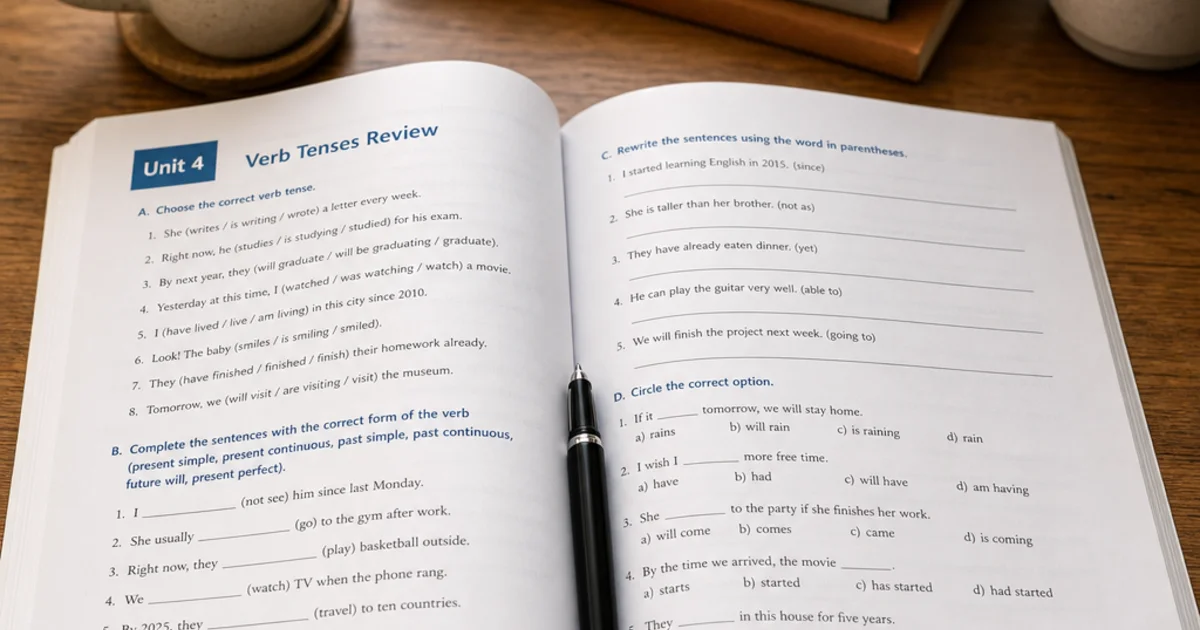
English has twelve tense forms built from past, present, and future crossed with simple, continuous, and perfect. Most everyday writing uses about six of them. A quick map: simple present for facts and habits (She works downtown), present continuous for now (She is working), simple past for finished events (She worked late), present perfect for past with present relevance (She has worked here for years), past continuous for background (She was working when I called), and future with will or going to for plans and predictions.
Conditionals and the verb ‘if’
Conditionals link a condition to a result. The four types are worth knowing by pattern rather than by number.
Zero (facts): If you heat water to 100°C, it boils.
First (likely future): If it rains tomorrow, we will cancel the picnic.
Second (hypothetical present): If I had more time, I would learn the piano.
Third (unreal past): If I had studied harder, I would have passed the exam.
The Oxford Learner's Grammar explains how the tense in the if-clause sets the meaning.
Conditionals: the logic of hypothetical situations
Conditionals let you talk about cause and effect across real and imagined scenarios, and English has four main types that follow predictable patterns. The zero conditional describes general truths: “If water reaches 100°C, it boils.” The first conditional handles likely future situations: “If it rains tomorrow, we will postpone the picnic.” The second conditional deals with unlikely or hypothetical presents: “If I had more time, I would learn the piano.” The third conditional reflects on unreal pasts: “If I had studied harder, I would have passed the exam.”
Mixed conditionals combine elements, such as a past condition with a present result: “If I had taken that job, I would be living in Berlin now.” The key is to identify which time frame each clause refers to and choose the verb form accordingly. Once the pattern clicks, conditionals become one of the most expressive tools in English, allowing you to reason about alternatives, regrets, and possibilities with precision.
Articles: the small words that cause big problems
The articles a, an, and the are among the hardest features of English for speakers of languages that lack them. The basic rule is straightforward: use a or an when introducing something new or referring to something non-specific, and use the when both speaker and listener know which specific thing is meant. “I saw a dog. The dog was barking.” — first mention is indefinite, second is definite because it refers back.
The difficulty lies in the exceptions. We do not use articles with most proper nouns (Paris, not the Paris), with plural or uncountable nouns used generally (Dogs are loyal, not The dogs are loyal when speaking about dogs in general), or with certain institutions (go to school, in hospital in British English). These patterns are best learned through extensive reading and targeted practice rather than through memorising rules alone, because context determines the correct choice more often than any single rule does.
Lesson summary
- Grammar is the invisible architecture of meaning; mastering the fundamentals unlocks everything else.
- Conditionals follow four predictable patterns that let you express real and hypothetical situations precisely.
- Articles are best learned through extensive reading and targeted practice, not rule memorisation alone.
- Self-correction habits — reading aloud and keeping an error log — catch recurring mistakes early.
- Sentence variety, achieved through subordination and varied openings, makes writing more engaging.
Learner questions
Do I need to know all grammar rules to speak well?
Is it okay to end a sentence with a preposition?
What is the difference between 'who' and 'whom'?
When should I use a semicolon instead of a period?
Further reading
Guidance is drawn from the authoritative ELT sources above. Examples and explanations are provided for educational purposes; always check current exam specifications on the official test websites.