Learning Strategies for English: A Clear Guide
✅ Reviewed by James Okoro, Curriculum Writer — MA Applied Linguistics, for accuracy against current ELT practice and exam specifications.
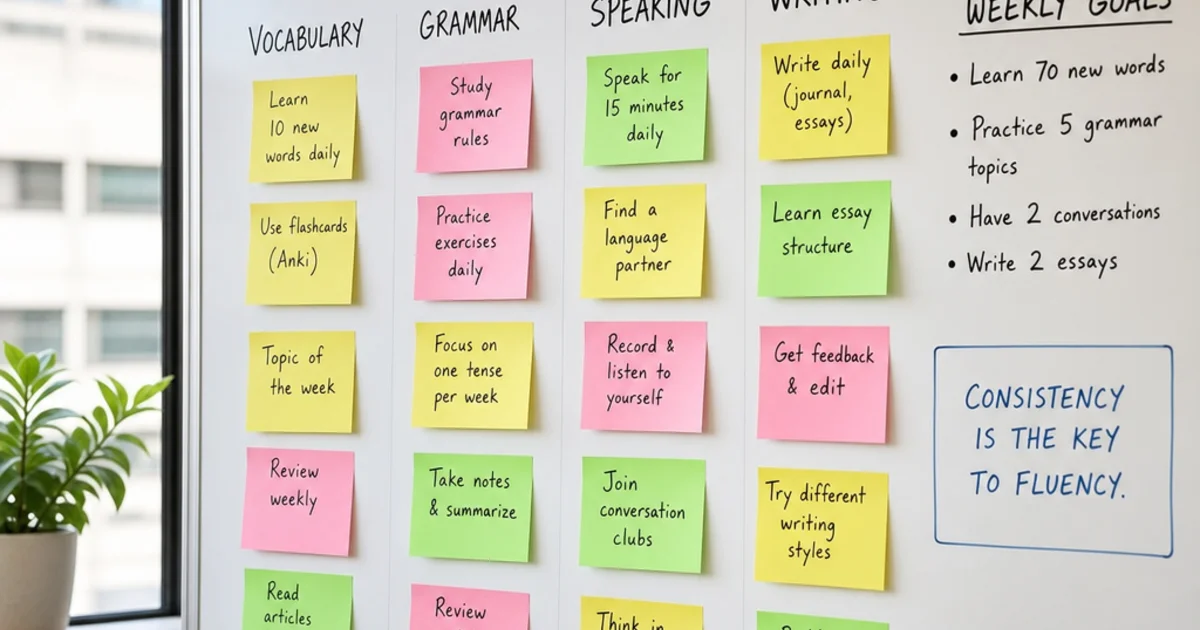
Set a concrete, measurable goal
‘Improve my English’ is too vague to guide daily decisions. A concrete goal gives you a target and a finish line: ‘Reach IELTS band 7 by March’, ‘Give a 10-minute presentation in English at work’, ‘Read a novel in English by December.’ A specific goal tells you what to study each day and when you have arrived.
A daily routine beats occasional marathons
Twenty minutes a day, every day, outperforms three hours once a week. Language lives in the brain through frequency, not volume. Build a small daily habit — listen to a short podcast on your commute, read one article over coffee, write three sentences before bed — and protect it. Consistency compounds; cramming does not.
Active study over passive exposure
Watching films and scrolling social media in English helps, but it is passive and slow. Pair it with active study: look up and record new words, write summaries of what you heard, repeat phrases aloud, test yourself on vocabulary. Active study is harder and far more effective. The Cambridge English — Learning English and VOA Learning English offer material suited to active practice.
Balance the four skills
Reading, listening, speaking, and writing each reinforce the others, so do not neglect any. Many learners over-focus on one (often reading) and underdevelop another (often speaking). Spread your week across all four, even briefly. A balanced routine produces a balanced ability.
Keeping motivation over months
Motivation fades; systems last. Track small wins (words learned, minutes studied, conversations had) so progress is visible. Connect English to something you already enjoy — a hobby, a career goal, a person — so the language serves a purpose beyond itself. When motivation dips, rely on the routine you built while motivated.
Spaced repetition: why timing beats intensity
If you study a new word for thirty minutes today and never review it, you will likely forget most of it within a week. But if you study it for five minutes today, review it tomorrow, again in three days, again in a week, and again in two weeks, the same word becomes permanently embedded. This is spaced repetition, and it is one of the most robustly supported findings in cognitive science. The spacing forces your brain to retrieve the information just as it is beginning to fade, and each successful retrieval strengthens the memory trace.
You can implement spaced repetition manually with a calendar, or use software designed for it. The principle is the same: schedule reviews at increasing intervals, and only revisit items you cannot recall. Items you remember easily get longer intervals; items you struggle with get shorter ones. Apply this to vocabulary, grammar patterns, irregular verb forms, and any other material you need to retain long-term. Twenty minutes of spaced review daily will outperform two hours of cramming the night before an exam, every time.
Comprehensible input and the power of extensive reading
Linguist Stephen Krashen argued that language is acquired not through deliberate study but through exposure to input that is slightly above the learner’s current level — what he calls i+1. When you read or listen to material that is challenging but not overwhelming, your brain absorbs grammar and vocabulary naturally, the way children do. The key is volume and pleasure: find content you genuinely enjoy — graded readers, young adult novels, podcasts on topics you care about — and consume it regularly.
Extensive reading — reading large quantities of relatively easy material for pleasure, not stopping to look up every word — is particularly powerful. It builds vocabulary through context, internalises grammar patterns through repeated exposure, and develops a feel for natural English that no textbook can teach. Aim for material where you understand roughly 95-98 percent of the words so that you can infer the rest. If you are stopping to use a dictionary more than once per page, the text is too hard; switch to something easier. The goal is to read so much that English becomes a tool for accessing content you love, not a subject you study.
Lesson summary
- Set SMART goals and focus on one or two priority skills rather than trying to improve everything at once.
- Spaced repetition — reviewing at increasing intervals — is the most efficient way to retain vocabulary long-term.
- Extensive reading of enjoyable, slightly-challenging material builds natural fluency better than any textbook.
- Track your progress with simple metrics to stay motivated and catch plateaus early.
- Consistency beats intensity: twenty minutes daily outperforms occasional marathon sessions.
Learner questions
How long does it take to become fluent in English?
Is it better to study alone or with a teacher?
How much should I study English each day?
Is it better to focus on one skill at a time or mix them?
Further reading
Guidance is drawn from the authoritative ELT sources above. Examples and explanations are provided for educational purposes; always check current exam specifications on the official test websites.